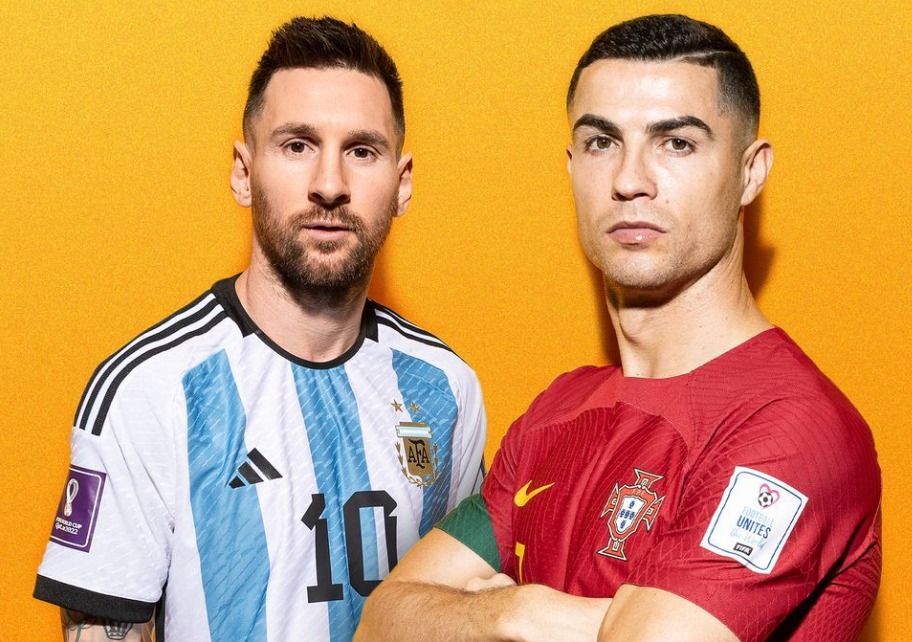

The debate between Lionel Messi and Cristiano Ronaldo has divided football fans for nearly two decades. But according to a new academic study, your preference for one over the other may say something deeper than just your taste in football — it may reflect your political worldview.
The Study
The debate between Lionel Messi and Cristiano Ronaldo has divided football fans for nearly two decades. But according to a new academic study, your preference for one over the other may say something deeper than just your taste in football — it may reflect your political worldview.
Researchers at Nanyang Technological University (NTU) Singapore surveyed more than 10,000 people across 26 countries between April and May 2026. The paper, titled “Political Identity Beyond Politics: The Messi-Ronaldo Preference Across 26 Countries”, was published on the academic preprint platform SSRN and quickly attracted international media attention, including coverage by the French sports daily L’Equipe.
The central finding: political ideology is the single strongest predictor of whether someone prefers Messi or Ronaldo — outweighing age, nationality, personality traits, cognitive ability, and media consumption habits.
What They Found
The pattern that emerged from the data was consistent across borders: people who lean liberal or progressive tended to favour Messi, while those with more conservative or right-leaning views were more likely to side with Ronaldo.
The researchers point to the contrasting public personas of the two players as a key explanation. Messi is widely associated with a humble, team-first image — letting his football do the talking, deflecting praise to teammates, and projecting a quieter, more collective identity. Ronaldo, by contrast, is known for openly celebrating individual achievement, projecting confidence and ambition, and cultivating a bold, aspirational personal brand.
These images, the study argues, resonate differently depending on the values a person holds. Progressive, analytically-minded individuals tend to connect with Messi’s ethos. Those who value authority, self-reliance, and individual success are more drawn to Ronaldo.
Beyond political ideology, the study also identified other independent predictors of Ronaldo preference: higher levels of self-esteem, a more authoritarian personality orientation, and a tendency to consume news via short-form video platforms.
The connection between political beliefs and football preference was found to be most pronounced among younger respondents, gradually weakening with age.
Read With Caution
The study’s findings are striking, but its authors are careful not to overstate them.
First, the paper has not yet been peer-reviewed. Published as a preprint, it represents work-in-progress research that has not been independently validated by the broader scientific community — a standard step before findings are considered fully established.
Second, the effect, while statistically real, is modest in scale. One co-author put it plainly: “The study predicts, it doesn’t determine.” In practice, this means that someone who is slightly more conservative than their compatriots will, on average, rate Ronaldo slightly higher — not that every conservative is a Ronaldo fan or every progressive a Messi devotee. Exceptions abound, and individual preference remains shaped by countless personal factors.