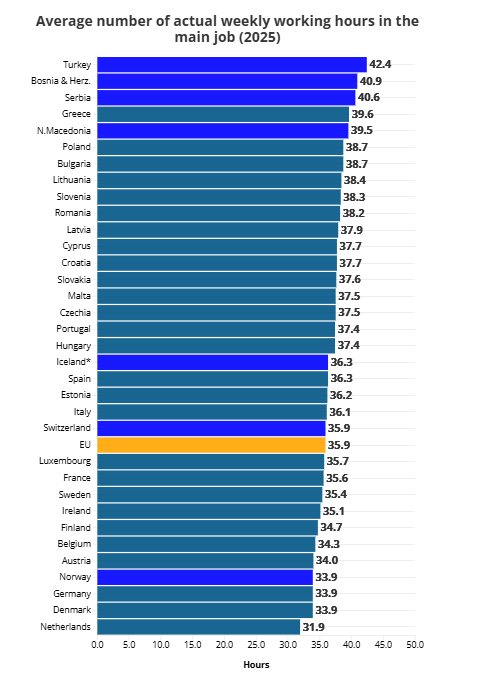
New Eurostat data reveal significant differences in the length of the working week across Europe, with the gap between countries with the longest and shortest working hours reaching nearly eight hours per week. According to the statistics, the average citizen in the European Union works 35.9 hours per week, but this figure varies significantly depending on the country, economic model, and the share of part-time work.
The longest average working time is recorded in Turkey, where workers spend an average of 42.4 hours per week at work. They are followed by Bosnia and Herzegovina with 40.9 hours and Serbia with 40.6 hours. These three countries are the only ones in the analysis where the average exceeds 40 hours per week, roughly equivalent to more than eight hours per day in a five-day working week.
Within the European Union and the broader European area, Greece ranks highest with 39.6 hours, followed closely by North Macedonia with 39.5 hours, and Bulgaria with 38.7 hours. These data show that countries in Southeast Europe and the Balkans dominate the category of the longest working weeks.
Experts attribute part of the reasons to lower productivity, weaker worker bargaining power, and different systems for setting working hours, where employers often have greater influence over working time.
At the opposite end of the scale are countries with significantly shorter working hours. The Netherlands has the shortest working week in Europe at 31.9 hours. It is followed by Germany, Norway, and Denmark with 33.9 hours each, as well as Austria (34.0), Belgium (34.3), and Finland (34.7). In these countries, the average working day is under seven hours, based on a five-day working week.
Experts explain that a key factor is the structure of the labour market. In the Netherlands, for example, nearly 43% of employees work part-time, which significantly reduces the average number of weekly working hours.
In addition, collective agreements and the widespread use of flexible working models contribute to a shorter working week in parts of Western European countries.
Eurostat data show a clear geographical divide: the longest working weeks are concentrated in Turkey and the Balkans, while the shortest are in Western and Northern Europe, led by the Netherlands. The gap between the extremes reaches nearly eight hours per week, raising questions about productivity, labour rights, and economic models across the continent.